If you have ever driven through Holmby Hills and wondered why the neighborhood feels so distinct, the answer is not just size or privacy. It is architecture working together with land, landscape, and estate planning. For buyers, sellers, and homeowners, understanding those design patterns can help you better read value, character, and long-term upkeep in one of Los Angeles’ most recognizable estate neighborhoods. Let’s dive in.
Holmby Hills Was Planned for Estates
Holmby Hills did not evolve as a tight grid of similar homes. According to Los Angeles planning materials, it was developed as an early planned estate community on the former Wolfskill Ranch, with more than 75 irregular parcels, gently sloping streets, narrow roads without sidewalks, historic streetlamps, and mostly single-family houses screened by hedges, walls, and gates.
That layout still shapes how the neighborhood looks and feels today. Even the smallest lots were originally sold at three-quarters of an acre, and larger parcels were intended to accommodate lawns, gardens, pools, and tennis courts. In Holmby Hills, the house has always been only part of the composition.
Period Revival Defines the Core Look
The architectural language most closely tied to Holmby Hills is Period Revival. City survey materials connect this tradition to Los Angeles residential design from the 1920s through the 1940s, especially in neighborhoods known for craftsmanship, scenic siting, and expressive materials.
In Holmby Hills, that broad category includes several estate styles that still shape the neighborhood’s identity. You will often see homes influenced by:
- Spanish Colonial Revival
- Mediterranean Revival
- American Colonial Revival
- Tudor Revival
- French Norman or French Revival
- Georgian Revival
- Neoclassical design
These styles differ in detail, but they tend to share a certain formality. You see intentional massing, carefully composed facades, strong rooflines, and materials selected to create a sense of permanence.
Why Period Revival Works So Well Here
Holmby Hills gives these houses room to breathe. Large setbacks, mature landscaping, and irregular estate parcels allow architecture to unfold gradually from the street rather than reveal itself all at once.
That matters because many classic estate styles depend on arrival and framing. A gated drive, a long hedge line, a courtyard, or a carefully placed front elevation can make the house feel more monumental without relying on sheer square footage.
Spanish and Mediterranean Influence
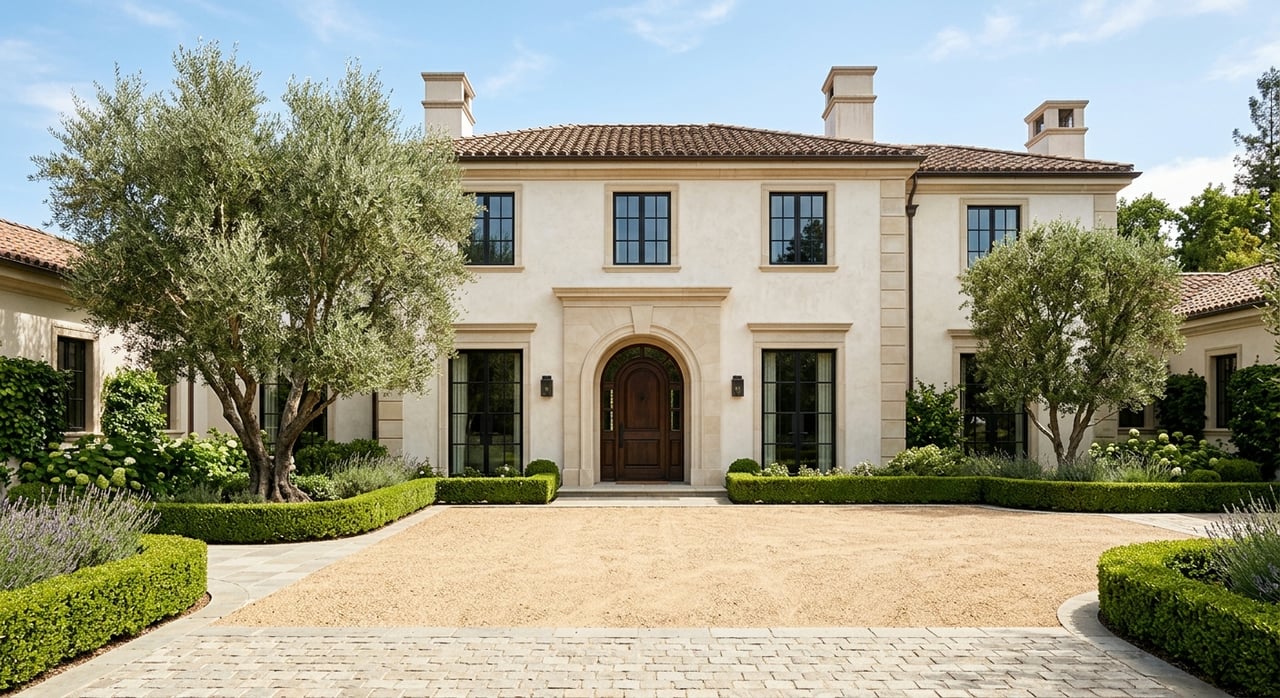
Among the most recognizable looks in Holmby Hills are Spanish Colonial Revival and Mediterranean Revival homes. These styles fit Southern California naturally, and they became central to the neighborhood’s early luxury identity.
SurveyLA identifies the Emma Janss Residence as a Spanish Colonial Revival house and one of the earliest residences in Holmby Hills. That kind of early showcase home helped establish the tone for what the neighborhood could be: elegant, climate-aware, and rooted in a strong visual vocabulary.
Common Traits of These Homes
While each estate is different, Spanish and Mediterranean-inspired homes often feature elements such as:
- Stucco exteriors
- Tile roofs
- Arched openings
- Courtyards or terrace relationships
- Indoor-outdoor planning
- Decorative iron or carved detailing
In Holmby Hills, these details usually work in tandem with the larger site. The architecture is important, but so are the gardens, paths, walls, and mature trees around it.
French, Georgian, and Neoclassical Estates
Holmby Hills is also known for estates with a more formal European or classically derived look. French Revival, Georgian Revival, and Neoclassical designs bring a different kind of presence, often more symmetrical and composed.
These homes can feel especially well suited to the neighborhood’s broad lots and long approaches. Their design language often emphasizes balance, proportion, and a sense of old-world permanence, which continues to appeal to buyers who want a traditional estate expression rather than a purely contemporary one.
A Later Example of Classical Appeal
The Singleton Estate on Delfern Drive is a useful example. It is a 1970 French Provincial or French Revival estate by Wallace Neff, with landscape work by Thomas Church and Philip Shipley, and it was designated a Historic-Cultural Monument by the City in 2016.
What makes that significant is timing. Even though it came later than the earliest wave of Holmby Hills development, it still reads as deeply classical, showing that the neighborhood’s taste for formal estate design continued well beyond the 1920s and 1930s.
Famous Architects Shaped the Neighborhood
Part of Holmby Hills’ identity comes from who designed many of its estates. City planning sources note that leading architects associated with the neighborhood include Paul R. Williams, Wallace Neff, Gordon Kaufmann, George Washington Smith, and Roland E. Coate.
For buyers and sellers, that kind of authorship matters. In a neighborhood where individual estates often carry more historical significance than the neighborhood as a whole, a documented architect can add context, scarcity, and long-term appeal.
Why Architectural Authorship Matters
Holmby Hills is not described by SurveyLA as a fully cohesive historic district. Instead, its significance often rests in notable individual estates, especially homes tied to early development, recognized architects, preserved siting, or surviving landscape design.
That means the story behind a property can be just as important as its finish level. A home with strong provenance may stand out because it reflects the original estate vision of Holmby Hills in a way that newer construction cannot fully replicate.
Estates Here Are About the Whole Property
One of the biggest mistakes people make is judging a Holmby Hills property by the house alone. In this neighborhood, architecture is inseparable from the lot.
Privacy walls, hedges, gates, wide setbacks, mature trees, and estate-scale grounds are part of the design language. That is true whether the home is a 1920s revival estate or a newer custom residence.
Site Design Adds Character and Value
Large and irregular parcels are part of what gives Holmby Hills its enduring identity. According to city survey findings, intact estate siting and surviving landscape design are harder to replicate than interior square footage.
That helps explain why provenance and preservation often carry weight here. When many original homes have been demolished and replaced, the estates that still preserve their architectural intent and site planning become a more limited resource.
Modern and Contemporary Homes Also Have a Place
Holmby Hills is not frozen in one era. SurveyLA notes that many homes in the neighborhood have been demolished and replaced, and that there is no longer a fully consistent pattern of development or architectural style.
That has opened the door to later interpretations, including modern and contemporary residences. In the broader Holmby and Westwood estate area, the Brody Residence in Little Holmby is cited as an important mid-century modern example by A. Quincy Jones, with Garrett Eckbo and William Haines, showing how modern design entered the estate landscape without erasing the neighborhood’s earlier revival base.
What This Means for Today’s Buyers
If you are shopping in Holmby Hills, you are likely comparing very different design philosophies. Some homes emphasize historical detail, formal symmetry, and traditional materials, while others focus on cleaner lines, different indoor-outdoor relationships, and newer construction methods.
The key is understanding what is truly scarce on a given property. Sometimes it is the architecture itself. Other times it is the lot shape, the siting, the privacy, or the survival of original landscape character.
Maintenance Is Part of the Estate Equation
Owning or preparing to sell a Holmby Hills estate usually means thinking beyond cosmetic updates. Older estate properties can be more maintenance intensive because many design features that create charm also require ongoing care.
City planning materials point to elements such as roof form, brick veneer, French doors, dormers, gardens, pools, ponds, and tennis courts as part of an estate’s architectural character. Those features can support value and visual appeal, but they also affect maintenance scope, vendor coordination, and long-term planning.
Newer Construction Changes, But Does Not Eliminate, Upkeep
A newer custom home may shift the maintenance mix, but it does not remove the importance of site work, privacy screening, and landscape management. In Holmby Hills, grounds are not secondary. They are part of the product.
For sellers, this means presentation goes beyond interiors. For buyers, it means evaluating not only design taste but also how the house and site will function over time.
Historic Status Can Affect Renovation Plans
Some Holmby Hills properties may carry local preservation considerations. If a property is designated as a Historic-Cultural Monument, the City reviews demolition, substantial alteration, and relocation under the Cultural Heritage Ordinance.
That can affect renovation scope, project timing, and decision-making during ownership or pre-sale planning. Owners of Historic-Cultural Monuments, and contributing properties in HPOZs, may also be eligible for preservation incentives such as Mills Act property-tax relief.
Why This Matters in a Transaction
For buyers, preservation status can shape what changes are realistic after closing. For sellers, it can influence how a property is positioned, how improvements are documented, and how timelines are managed.
This is one reason local neighborhood literacy matters so much in Holmby Hills. Two estates with similar square footage can present very different opportunities depending on architecture, site integrity, and any preservation context.
Reading Long-Term Value in Holmby Hills
In a neighborhood like Holmby Hills, value is not only about bigger interiors or newer finishes. Scarcity often lives in things that are difficult to recreate, such as estate-scale parcels, intact siting, architectural authorship, and mature landscape design.
That is especially true in a neighborhood where many original homes have already been replaced. The remaining estates that preserve a strong connection to Holmby Hills’ original design logic can stand apart because they offer something increasingly limited.
Whether you are buying, selling, or simply studying the neighborhood, that perspective helps you look past surface-level luxury. It helps you see why certain homes feel lasting, and why architecture in Holmby Hills is really about the relationship between the residence, the land, and the story each property carries.
If you are considering a move in Holmby Hills or anywhere on the Westside, working with someone who understands both design context and market positioning can make the process far more strategic. For tailored guidance on buying, selling, or evaluating estate property, connect with Mitch Bassett.
FAQs
What architectural styles are most common in Holmby Hills?
- Holmby Hills is most closely associated with Period Revival architecture, including Spanish Colonial Revival, Mediterranean Revival, Tudor Revival, French Revival, Georgian Revival, American Colonial Revival, and Neoclassical homes.
Why does Holmby Hills architecture feel different from other Los Angeles neighborhoods?
- The neighborhood was planned as an estate community with large irregular parcels, narrow roads, wide setbacks, privacy walls, hedges, gates, and substantial grounds, so the overall setting shapes the architecture as much as the houses themselves.
Are all Holmby Hills homes historic in style?
- No. Survey findings note that many homes have been demolished and replaced, so Holmby Hills now includes a less consistent mix of older revival estates alongside newer custom homes and some modern influences.
Do famous architects have a strong presence in Holmby Hills?
- Yes. City planning sources associate Holmby Hills with noted architects such as Paul R. Williams, Wallace Neff, Gordon Kaufmann, George Washington Smith, and Roland E. Coate.
Does a Holmby Hills estate’s land matter as much as the house?
- Yes. In Holmby Hills, lot size, irregular parcel shape, privacy screening, landscape design, and estate siting are central to how a property looks, functions, and holds long-term appeal.
Can historic designation affect a Holmby Hills remodel or sale?
- Yes. If a property is a local Historic-Cultural Monument, the City reviews demolition, substantial alteration, and relocation, which can affect renovation scope, timing, and planning decisions.