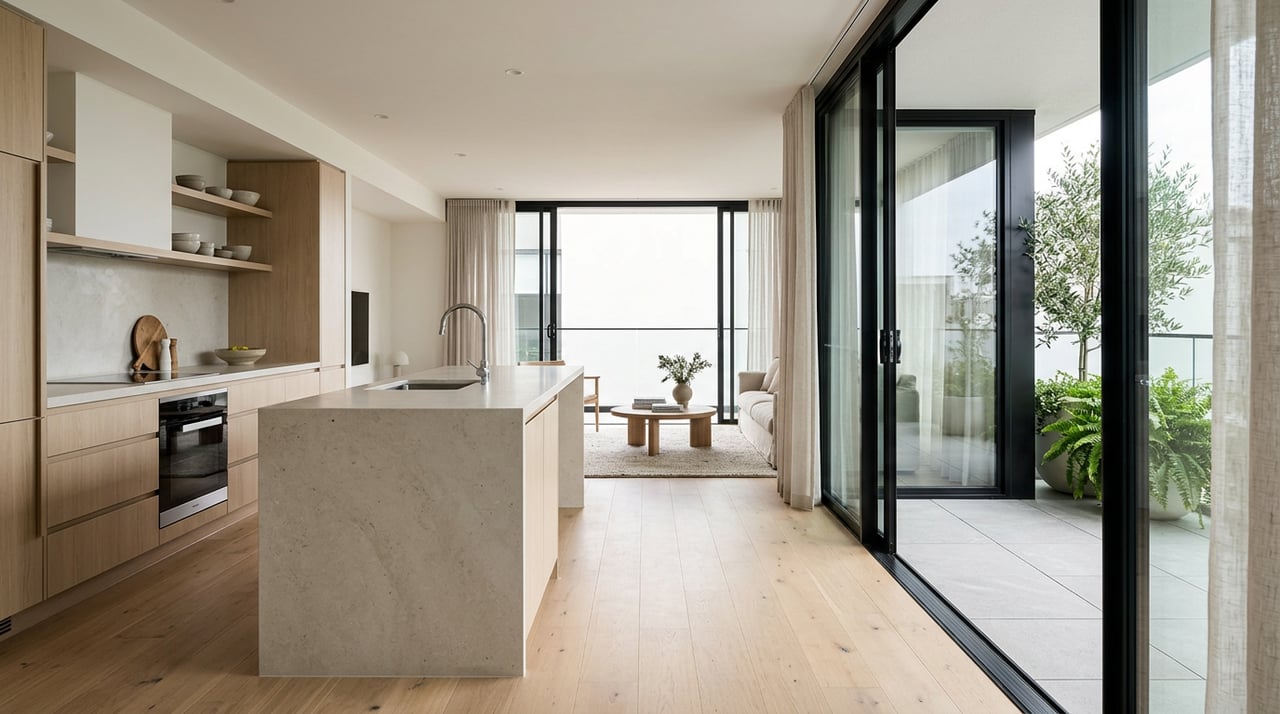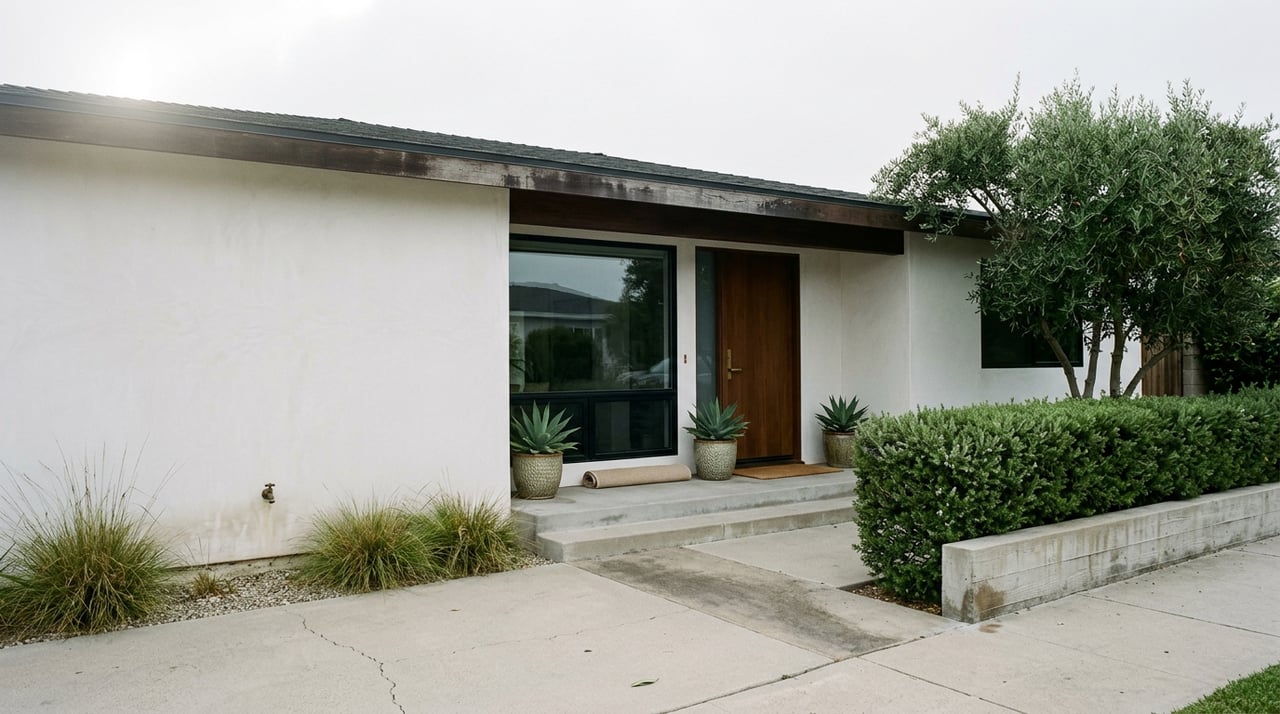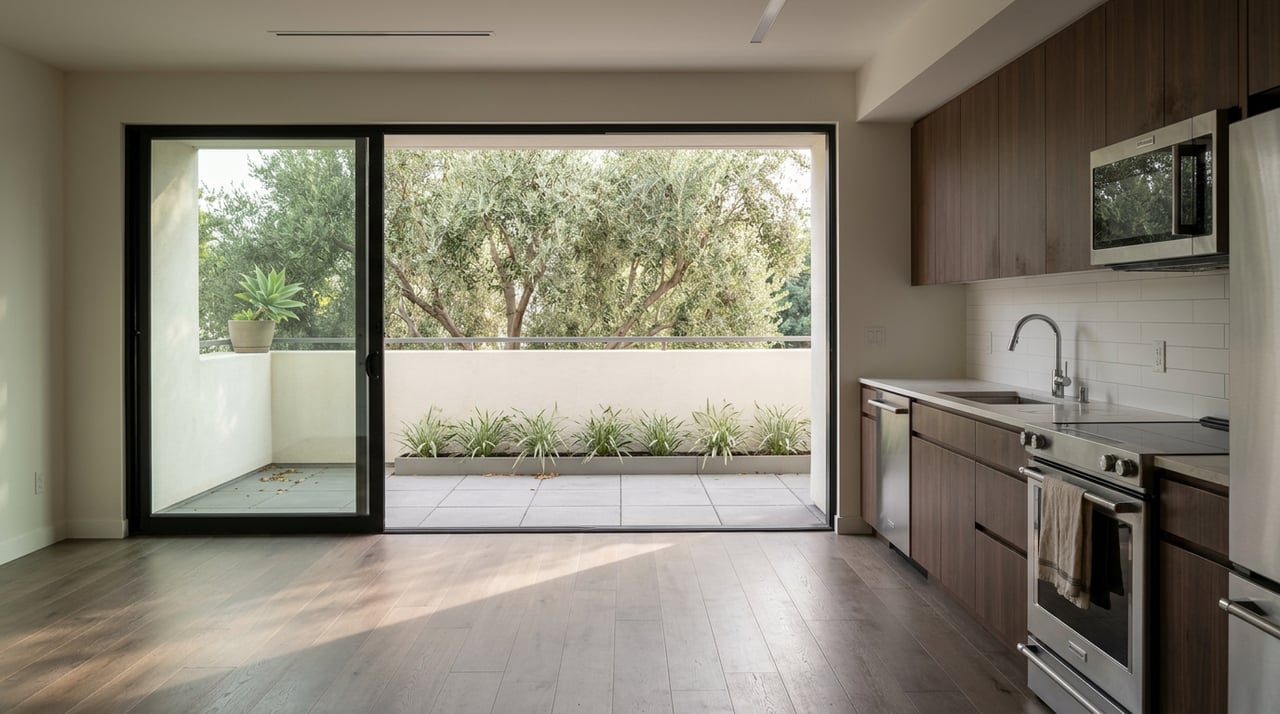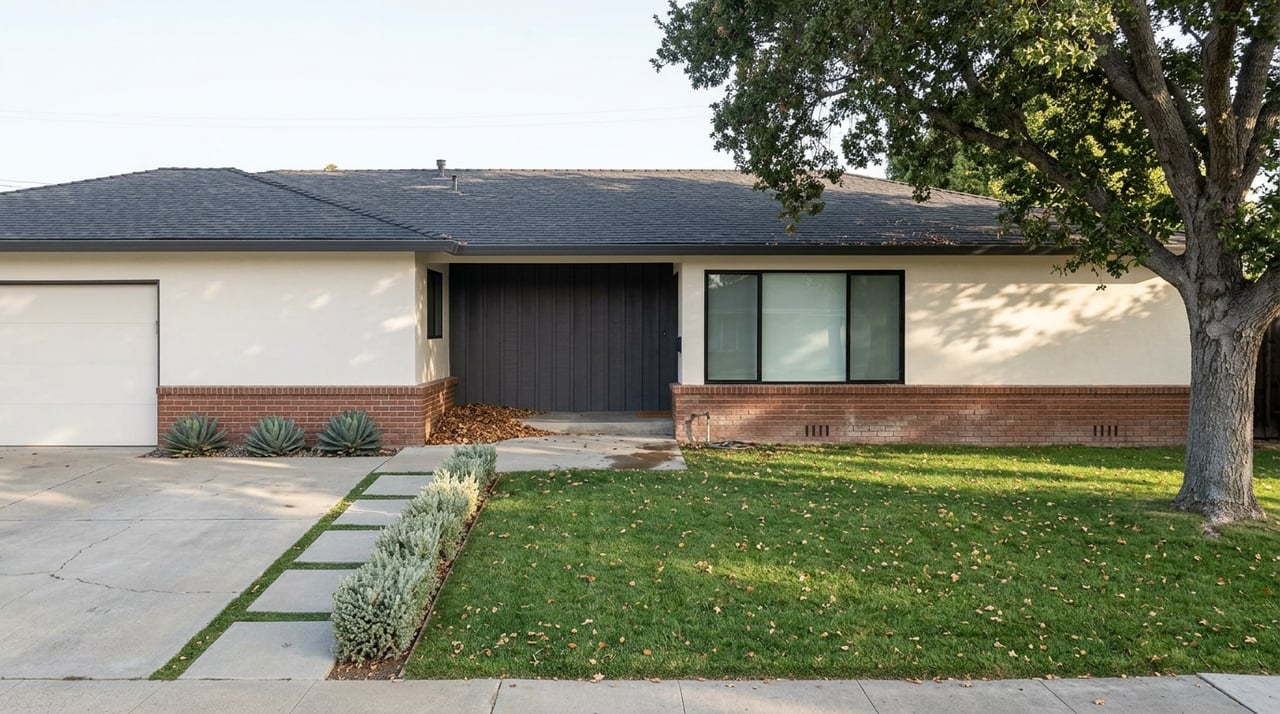
A buyer looking at a three-bedroom near Manchester Square in Westchester will usually hear the same pitch twice. First, the price is lower here because of the flight paths, so you're getting more house for less money. Second, don't worry about the noise for long, because once the new train opens at 96th Street, this pocket is going to catch up fast. Both halves of that pitch are grounded in something real. Only one of them is happening on a schedule anyone can actually promise.
The train is SkyLink, the automated people mover that's supposed to connect LAX's terminals to the Metro Transit Center a few blocks from Westchester's southeastern edge. As of the most recent public updates this summer, it was more than 99 percent built, with trains visibly running test loops on the elevated guideway. It is also tangled in a lawsuit, sitting on a credit downgrade, and racing two deadlines this fall that could trigger default. If you're comparing Westchester sub-pockets right now, that distinction between "almost open" and "financially secure" is worth more than any single comp.
The Same Zip Code, Six Different Markets
Westchester's citywide numbers flatten a neighborhood that doesn't behave like one market. As of August 2026, turnkey homes in Kentwood were trading between $1.8 million and $2.4 million, while comparable homes a few blocks away in Westport Heights ran $1.5 million to $2 million, a gap of $150,000 to $300,000 for houses that look similar on paper. Keep heading south and east toward the Playa del Rey border and the Osage and Emerson pockets, and entry-level three-bedroom homes were changing hands between $1.35 million and $1.65 million that same month.
That spread isn't random. It tracks almost exactly with distance from LAX departure and approach vectors. Homes in the southern and eastern sub-pockets sit closer to those flight lines and to corridors like Aviation Boulevard, and they trade 10 to 20 percent below northern pockets such as North Kentwood, which sees meaningfully less ambient aircraft noise. Kentwood's premium also comes from larger, flatter lots, but the airport geography does real work in the pricing.
Here's what that actually looked like in transaction data during the first quarter of 2026:
| Sub-pocket | Q1 2026 signal | What it tells a buyer |
|---|---|---|
| North Kentwood | 8 closed sales, median sold price $2,435,625, median price per square foot $1,002 (up 7.86% year over year) | Fewer transactions than a year earlier, but buyers are paying more per foot for larger homes. Demand at the top hasn't softened. |
| South Kentwood & Loyola Village | Median 10 days to go under contract, a 60% faster pace than a year earlier, with pricing steady | The fastest-moving pockets in the entire zip code. Sellers here aren't waiting. |
| Nielsen, Osage, Emerson Manor, West Westchester-South, Westchester Triangle | Combined sales volume rose from 6 transactions in Q1 2025 to 15 in Q1 2026, a 150% jump. Nielsen alone went from zero sales to seven | Volume is surging in the discounted pockets, which is exactly where the SkyLink story gets used as a selling point. |
| One Westbluff | Zero closed sales in Q1 2026 and zero in Q4 2025. Last comparable activity was Q1 2025, two homes at a median of $3,318,250 | A small, specialized enclave where quarterly data swings wildly. Don't read a trend into one quarter here. |
Look at the citywide headline and you'd think Westchester cooled off hard. The overall median sale price for single-family homes came in at $1.7 million in Q1 2026, a 17.7 percent decline from Q1 2025. But median price per square foot barely moved, down just 1.6 percent to $915. That gap between the two numbers is the tell. Home values didn't fall. The mix of what sold shifted toward the more affordable eastern and southern pockets, and the median followed the sales mix down, not because anyone's home lost value.
What the Discount Is Actually Pricing In
The flight-path discount isn't a soft, vague "some noise" adjustment. It's a specific, measurable gap tied to how close a lot sits to a departure or approach line, and it's been stable enough that agents can quote it in percentage terms rather than hedge with "it depends." That stability matters, because it means the discount isn't a temporary market quirk waiting to close. It's priced in the way earthquake retrofitting or a busy through-street gets priced in anywhere else in Los Angeles: durable, structural, and unlikely to disappear just because a market cools or heats up.
Which is exactly why the second half of the sales pitch, the one about SkyLink erasing the gap, deserves more scrutiny than it usually gets.
The Train That's 99 Percent Finished and Still Not Running
SkyLink was approved by the Los Angeles City Council back in April 2018 as a $4.9 billion project, and it was originally supposed to open in March 2023. It didn't. The 2.25-mile elevated line, with stations linking the Central Terminal Area, the LAX Rental Car Center, and the Metro Transit Center near Westchester's northeastern edge, is now more than 99 percent complete, and by LAWA's own account, the project has already paid out over $1 billion in contracts to local and diverse businesses and created nearly 10,000 construction jobs. It just still hasn't opened to the public.
The reasons are no longer purely technical. Reported construction costs have climbed to roughly $3.34 billion, and a Los Angeles County civil grand jury found the contractor consortium, known as LINXS, largely responsible for over $880 million in change orders. LINXS disagrees. In July 2026, the consortium sued the City of Los Angeles, alleging airport officials contributed to the delays by altering project drawings and creating obstacles of their own. The Los Angeles City Council got involved directly, referring the dispute to its Trade, Travel, and Tourism Committee on June 26, 2026.
Then came the financing problem. On July 21, 2026, Fitch Ratings downgraded roughly $1.2 billion in SkyLink's senior bonds from BB+ to BB, pushing them further into speculative-grade territory, and placed them on Rating Watch Negative. The agency's language was blunt: the project sits in a precarious position with a limited margin of safety before it could breach a lenders' longstop date of October 8, 2026, and a project longstop date of December 8, 2026. Missing either date counts as a default under the project's build-finance-operate-maintain agreement. Reporting in August 2026 floated October 6 as an informal target for the start of passenger service, but LAWA has not confirmed that as an official opening date.
To be fair, Fitch also noted that both LAWA and LINXS have a strong financial incentive to get the train running rather than let it default. That's a reasonable bet. It's still a bet, not a fact on the ground, and it's happening on a calendar where the first deadline falls roughly a month from today and the second about three months out.
Why the Timing Problem Matters for the Discounted Pockets
If you're evaluating a home in Osage, Emerson Manor, or along the Playa del Rey border and someone frames the flight-path discount as a closing window, that framing assumes SkyLink opens on schedule, stays financially sound, and pulls enough foot traffic and perception change toward those sub-pockets to move prices. Every one of those assumptions is currently uncertain, and the uncertainty is not hypothetical. It's sitting in a rating agency's public commentary with two named dates on the calendar.
The more useful way to read the discount right now is as a durable feature of these pockets, not a temporary discount waiting to be arbitraged away. If SkyLink opens on time and later reshapes how people think about proximity to the Metro Transit Center, that's genuine upside. If it doesn't, and the litigation or financing troubles drag past December, buyers who paid a premium expecting fast appreciation from transit access will have paid for a story rather than a transaction.
None of this changes the broader signal in the data: the southern and eastern pockets are seeing real transaction volume growth, up 150 percent year over year in Q1 2026, and that's demand responding to price, not to a train that isn't running yet. That's a healthier reason to buy there than a bet on a construction timeline.
The rest of the market context supports patience over urgency either way. Westchester's overall relist rate climbed to 17.8 percent of closed sales in Q1 2026, up from 9.6 percent a year earlier, meaning nearly one in five sellers had to pull a listing and try again, usually a sign of asking prices getting ahead of what buyers will pay. Months of supply sat at 4.1, close to the inflection point between a buyer's and seller's market. Mortgage rates hovered around 6.30 percent for a 30-year fixed as of Freddie Mac's April 30, 2026 survey, elevated enough that pricing discipline matters more than speed on either side of a deal.
FAQ
Will SkyLink opening actually raise prices in southeastern Westchester? It's plausible, but nothing in the current data confirms it will happen on any specific timeline. The project's own lenders have flagged the risk of missed deadlines this fall.
Is the flight-path discount likely to shrink regardless of SkyLink? The 10 to 20 percent gap has held steady enough to be quoted in transaction data, which suggests it's tied to a fixed geographic fact rather than a temporary market mood.
Why does the citywide Westchester median look like it dropped so much? Because more of the homes that sold in Q1 2026 came from the lower-priced eastern and southern pockets. Price per square foot, a better measure of actual value, barely moved.
How do I find out exactly how exposed a specific address is to flight paths? Pull up the property during peak arrival and departure hours and stand on the lot itself. Aggregate sub-pocket averages are a starting point, not a substitute for hearing what a given block sounds like at 7 a.m. and 9 p.m.
If you're weighing a Westchester purchase against the noise, the timeline, or both, Mitch Bassett can walk the specific block with you before you write an offer. Book an appointment and get a read on the pocket, not just the zip code.